

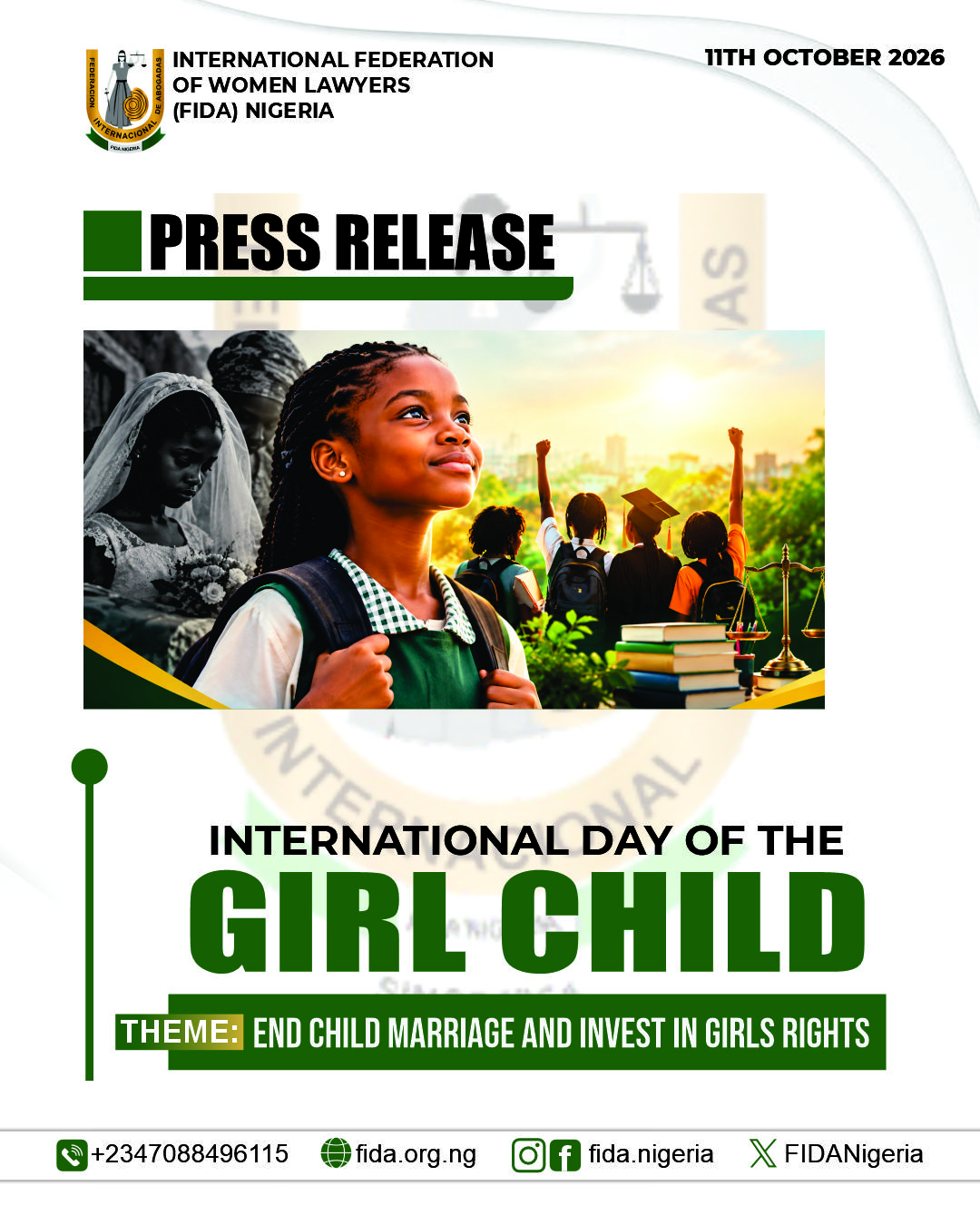
 by FIDA
PROTECTING THE GIRL, PROTECTING HER FUTURE: NIGERIA MUST END CHILD MARRIAGE AND INVEST IN GIRLS’ RIGHTS
A girl should have a say in who she becomes, what she wants to achieve and the life she wants to build. Her childhood should not be used to decide her future for her. No child should be betrothed, promised or told whom she must marry before she is old enough to make that decision for herself.
As the world marks the 2026 International Day of the Girl Child under the theme “End child marriage and invest in girls’ rights,” the International Federation of Women Lawyers (FIDA) Nigeria calls on government, institutions, communities and families to take urgent and concrete action to end child marriage and ensure that girls can exercise their rights in practice.
The latest available data shows that 33.4 per cent of young women in Nigeria were married before the age of 18. UNICEF also reports that 7.6 million Nigerian girls are out of school, with half of them in the North. Behind these figures are girls whose education, opportunities, autonomy and ability to shape their futures are being constrained.
Child marriage is not simply about the age at which a girl marries. It can disrupt her education, affect her health and economic prospects, limit her autonomy and increase her vulnerability to violence and coercion. Poverty, harmful social norms, discrimination and weak protection systems can further narrow the choices available to girls.
A girl does not become less entitled to her childhood because her family is poor, because a harmful practice is accepted in her community, or because the law is weakly enforced. Her rights remain hers.
THE LAW MUST PROTECT GIRLS IN PRACTICE
Nigeria has legal frameworks designed to protect children, including the Child Rights Act 2003, alongside applicable State child-protection legislation. But the existence of a law is not enough. A girl facing child marriage must be able to reach an institution, be heard without fear and receive protection and a remedy that can change her circumstances.
FIDA Nigeria therefore calls on the Federal and State Governments to:
- Strengthen the implementation and enforcement of existing child-protection laws and address gaps that leave girls vulnerable.
- Fund child-friendly justice and protection mechanisms so girls can report violations safely and receive timely support.
- Expand legal aid and protection services, particularly for girls in poor, rural, remote and underserved communities.
- Hold accountable those who facilitate, compel or perpetrate violations against children.
- Protect girls and survivors from retaliation, stigma and further harm when they seek justice.
- Measure progress by the number of girls actually protected, supported and able to remain in or return to school.
Government and education authorities must also keep girls in school and create genuine pathways for those who have dropped out, including married, pregnant and adolescent mothers, to return to education.
INVESTING IN GIRLS MEANS INVESTING IN THEIR FUTURES
Education gives girls knowledge, skills, confidence and greater choices about their futures. As Nigerian girls’ education advocate Toyin Chukwudozie has noted, completing 12 years of education can significantly reduce a girl’s vulnerability to child marriage.
Investment in girls must also include access to healthcare, social protection, legal assistance and safe spaces where they can speak and participate in decisions affecting their lives.
A girl’s future should not depend on where she lives, her family’s income, or whether she faces additional barriers because of disability, displacement or other forms of discrimination.
Every girl deserves the opportunity to choose her future.
On this International Day of the Girl Child, FIDA Nigeria urges Nigeria to measure progress not only by policies and laws, but by what girls experience in their daily lives. Can a girl facing child marriage find someone who will intervene? Can a girl who has dropped out return to school? Can a girl living in poverty obtain legal assistance? Can she speak about a decision affecting her life and know that someone with the power to act will listen?
These are the questions that should determine whether Nigeria is protecting its girls.
Ending child marriage means protecting a girl’s childhood, education, health, dignity, safety and ability to decide who she becomes. A girl’s future should not be decided for her before she is old enough to choose it.
FIDA Nigeria will continue to use the law, public advocacy and its work with communities to challenge practices that deny girls their rights and to press for responses that protect them in practice. Nigeria must make a clear choice: protect girls in practice, invest in their rights and give them the freedom to determine their own futures.
Signed
Eliana Martins
Country Vice President
FIDA Nigeria

