
 by FIDA
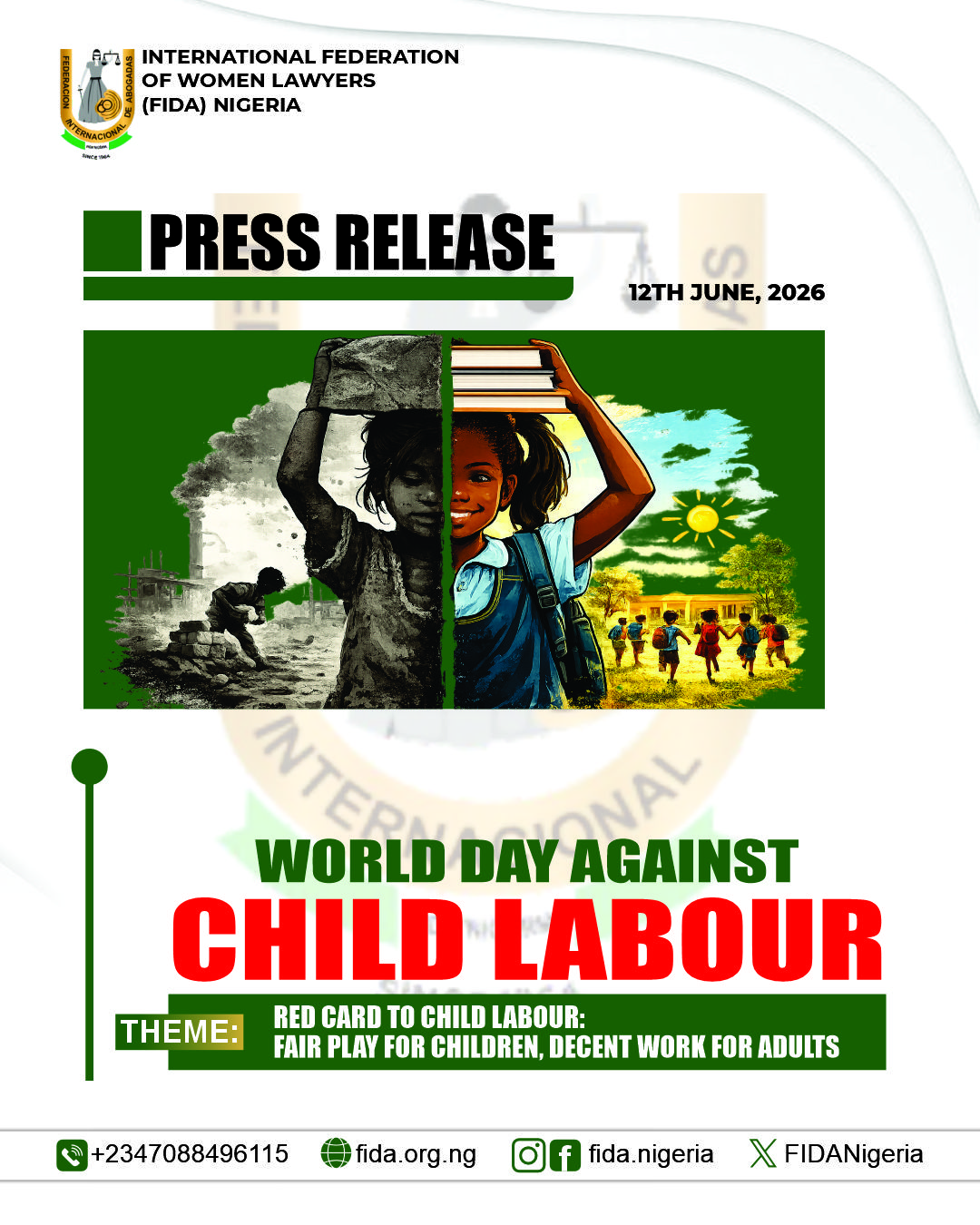
World Day Against Child Labour 2026 Theme: “Red Card to Child Labour: Fair Play for Children, Decent Work for Adults”
Every child carrying bricks instead of books is evidence of a promise broken.
Across Nigeria today, millions of children are trapped in labour when they should be learning, playing, and preparing for the future. Behind every statistic is a child whose dreams are being delayed, diminished, or denied altogether. A child selling goods under the scorching sun, working long hours in farms, markets, workshops, mines, or on the streets is not demonstrating resilience; that child is being failed by systems that were designed to protect them.
As the world marks the 2026 World Day Against Child Labour, the International Federation of Women Lawyers (FIDA) Nigeria joins the global call to show a red card to child labour and demand a society where every child enjoys the right to education, protection, dignity, and opportunity.
The reality before us is deeply troubling. According to the Nigeria Child Labour Survey 2022 conducted by the National Bureau of Statistics in collaboration with the International Labour Organization (ILO) and the Federal Ministry of Labour and Employment, approximately 24.7 million Nigerian children between the ages of 5 and 17 are engaged in child labour, while about 14.4 million are involved in hazardous work that threatens their health, safety, education, and overall development. These figures underscore the scale of the challenge and the urgency of sustained action to protect every child’s right to a safe, healthy, and productive childhood.
Child labour remains one of the most visible manifestations of poverty, inequality, weak social protection systems, and inadequate enforcement of child protection laws. Many families facing severe economic hardship are forced into impossible choices, while children bear the consequences. Yet poverty can never be accepted as justification for exposing children to exploitation, hazardous work, abuse, or conditions that rob them of their childhood and future.
Nigeria has already made clear legal and policy commitments. The Child Rights Act 2003 guarantees the protection, survival, development, and best interests of every child. The Labour Act establishes safeguards regarding the employment of children and young persons. Nigeria has also ratified the International Labour Organization Convention No. 138 on Minimum Age for Employment and Convention No. 182 on the Worst Forms of Child Labour, affirming its commitment to eliminating child labour in all its forms.
The challenge before us is no longer the absence of laws. It is the gap between commitment and implementation. It is the persistent gap between commitment and implementation, between promises made and protections delivered.
Far too many children remain exposed to hazardous labour, trafficking, exploitation, and other violations despite these protections. This demands stronger coordination and enforcement by relevant institutions, including the Federal Ministry of Labour and Employment, the Federal Ministry of Women Affairs, the National Agency for the Prohibition of Trafficking in Persons (NAPTIP), state governments, law enforcement agencies, and child protection authorities across the country.
FIDA Nigeria therefore calls for urgent and measurable action:
• The Federal Government must strengthen implementation of national child labour elimination strategies, expand social protection programmes for vulnerable families, and increase resources for labour inspections and child protection systems.
• State Governments must fully domesticate and effectively implement the Child Rights Act where gaps remain, while ensuring functional child protection mechanisms at state and local government levels.
• Employers and the Private Sector must conduct due diligence across their supply chains and adopt zero-tolerance policies against child labour in all forms.
• Communities, traditional institutions, religious leaders, and parents must actively report cases of child labour, trafficking, and exploitation and prioritize children’s education and wellbeing.
• Law enforcement and regulatory agencies must ensure that violators face swift investigation, prosecution, and appropriate sanctions.
A nation cannot build sustainable development on the backs of children whose rights are being denied. Every child withdrawn from school to work represents not only an individual tragedy but also a collective loss for Nigeria’s future.
On this World Day Against Child Labour, FIDA Nigeria reaffirms its unwavering commitment to protecting the rights of every child and advancing a Nigeria where no child’s future is sacrificed to poverty, exploitation, or neglect.
The choice before us is clear: either we protect children now, or we pay the price of failed potential for generations to come.
Children belong in classrooms, not worksites. Their hands should hold books, not burdens.
Signed
Country Vice President/National President
FIDA Nigeria

